


You Cleared the Biggest Hurdle. Here's What's Left.
Passing the NCLEX-RN puts you ahead of most people who attempt it. That exam is the single hardest technical checkpoint in this whole process, and clearing it proves you can practice at U.S. standards.
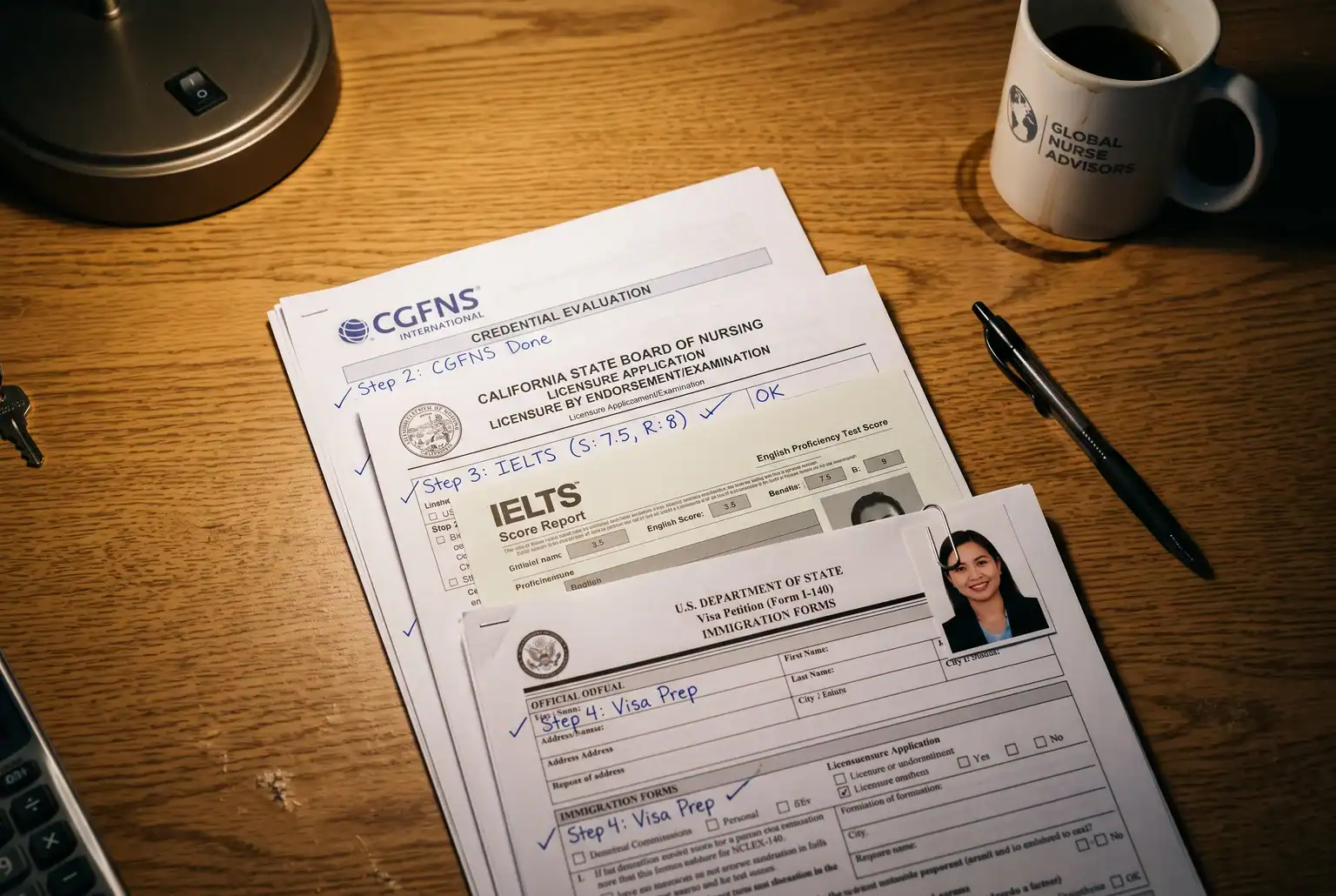
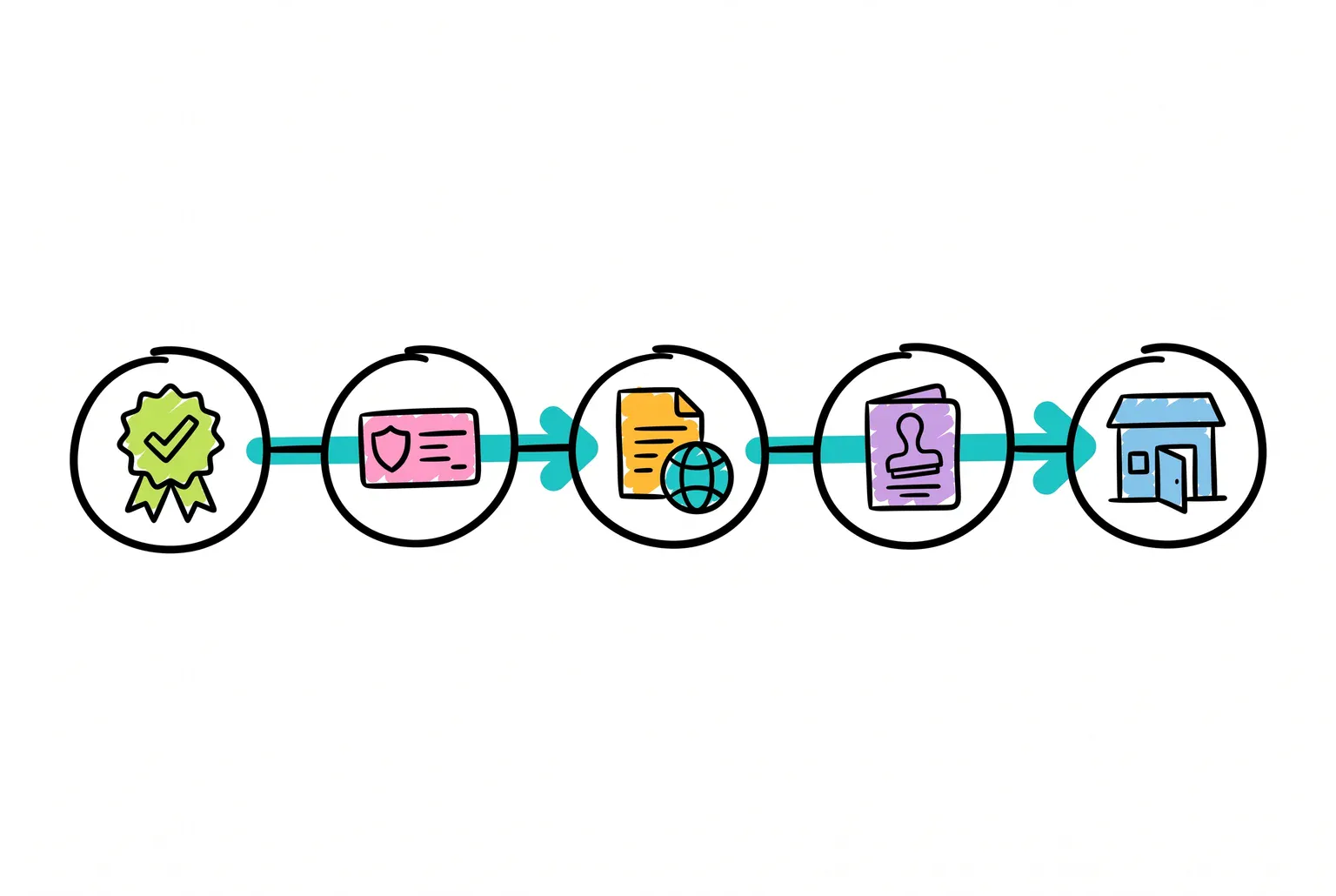
But passing it doesn't hand you a job. It makes you eligible to move to the next stage: applying to a state board of nursing for your license, completing credential verification through CGFNS or a similar service, confirming your English proficiency documentation is in order, sorting out a visa pathway like EB-3, H-1B, or TN, and then actually landing a U.S. job offer, whether through a recruiter, a staffing agency, or a direct hospital application.
Each of these steps has its own paperwork, timeline, and common pitfalls. None of them require you to study for another exam. From here on, it's administrative work and immigration logistics, not test prep, and every step is something you can plan for in advance.
Verifying Your Education and License Meet U.S. Standards
Before any state board will look at your application, it needs proof that your nursing degree and license are legitimate and equivalent to a U.S. RN's. That's what credential evaluation does.
The most widely recognized option is the CGFNS Certification Program, which verifies your secondary education, confirms you completed a registered nursing program, and validates your RN license directly with the licensing authority in your home country. CGFNS also requires you to pass its own Qualifying Exam and to submit proof of English proficiency through an approved test like TOEFL iBT. For nurses pursuing certain visa categories, CGFNS separately administers VisaScreen, a related but distinct credential check tied to immigration.
CGFNS isn't the only accepted evaluator. States like Texas and South Carolina list several approved alternatives, including agencies such as ERES, Josef Silny & Associates, and SpanTran. Which one you should use depends entirely on the state where you plan to get licensed, so check your target state board's website before paying for any evaluation.
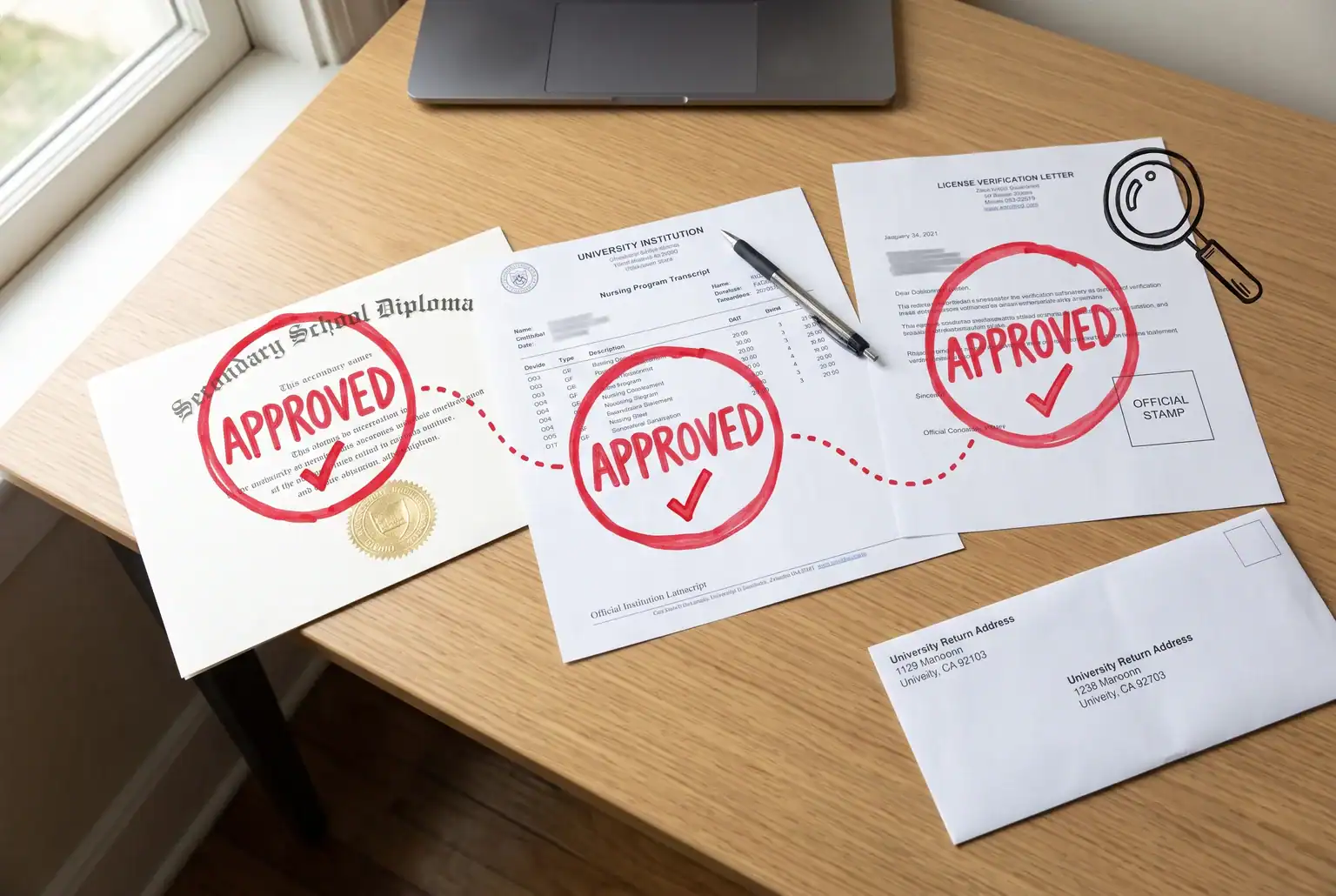
Expect to send transcripts and license verification directly from your school and licensing body. Third-party copies usually aren't accepted.
Do You Still Need an English Test?
If your nursing education wasn't taught in English at a recognized English-medium institution, most state boards will still require proof of English proficiency even after you've passed the NCLEX. Accepted tests typically include TOEFL iBT, IELTS Academic, PTE Academic, and OET, with minimum scores varying by state. Virginia, for example, asks for a TOEFL score of 83 with a 26 on speaking, while Pennsylvania sets similar thresholds.
Some states waive this requirement entirely. Washington accepts alternatives like 1,000 hours of U.S. nursing practice or a U.S. diploma instead of a test score.
Even if your target state doesn't require one, federal immigration processing through VisaScreen usually does. Exemptions there are narrow, generally limited to nurses educated in specific English-speaking countries. Check both your state board and VisaScreen requirements separately. They aren't always the same.
Getting Licensed in the State Where You'll Work
Licensure by endorsement typically means submitting a signed application with fees, sending an approved credential evaluation directly to the board, verifying your prior licenses through Nursys or a board-specific form, and completing a criminal background check with fingerprinting. If your education or exams weren't in English, expect to submit proof of proficiency here too.
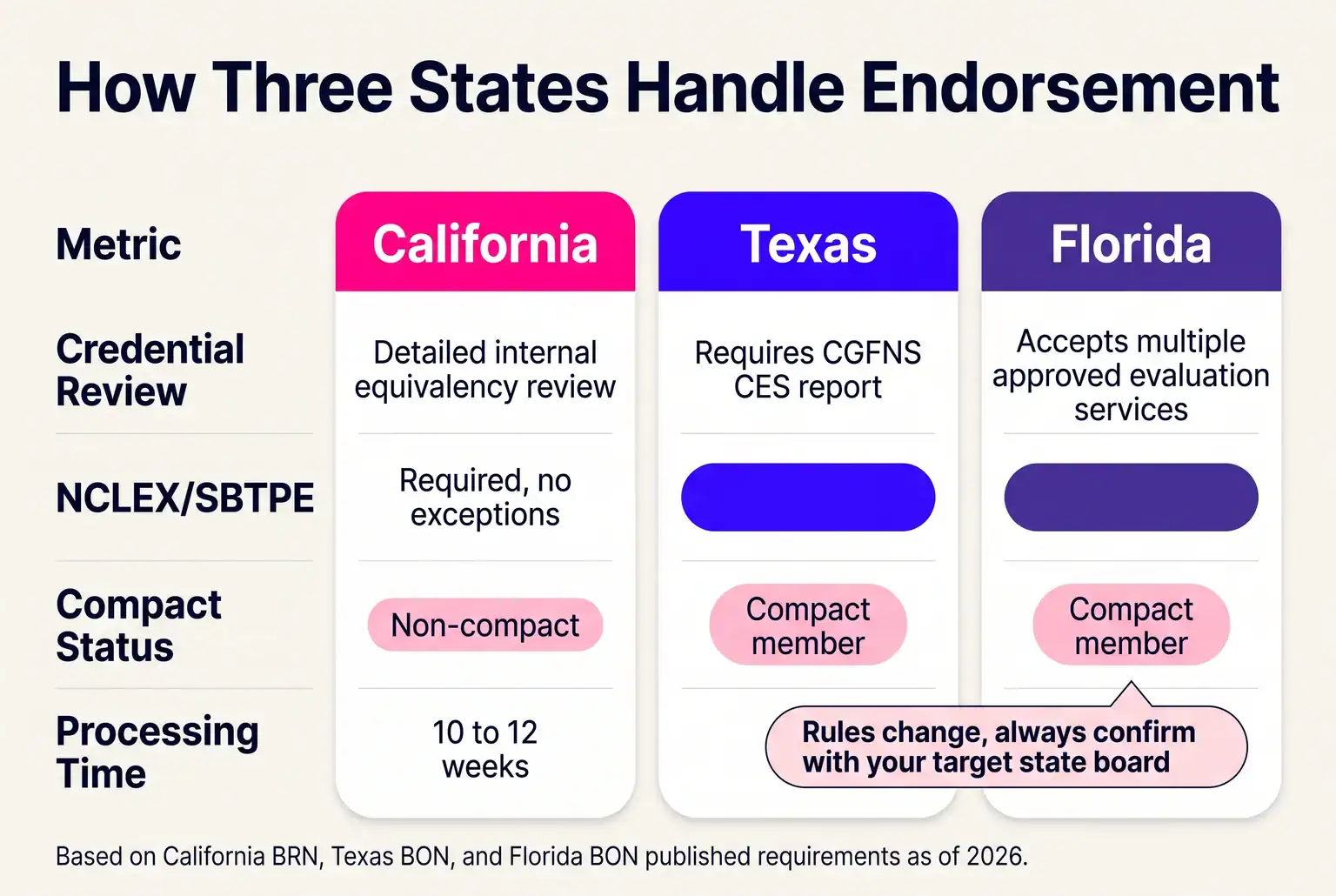
The details shift a lot by state. Texas requires a CGFNS Credential Evaluation Service report specifically. Florida accepts reports from several approved evaluation agencies and generally takes them at face value. California runs its own detailed review, checking that your program matched the theory and clinical hours required in medical-surgical, maternal, pediatric, and psychiatric nursing, and it won't endorse anyone who hasn't passed the NCLEX-RN or the older SBTPE. Mismatched timing between theory and clinical coursework is common enough that California often asks for make-up coursework in a U.S. program before licensing. Processing there currently runs 10 to 12 weeks.
Texas and Florida also belong to the Nurse Licensure Compact, so one license there covers practice in other compact states. California doesn't participate.
Check your target state board's website directly. The rules above change, and they aren't the same from state to state.
Choosing Your Visa Path: EB-3, H-1B, or TN
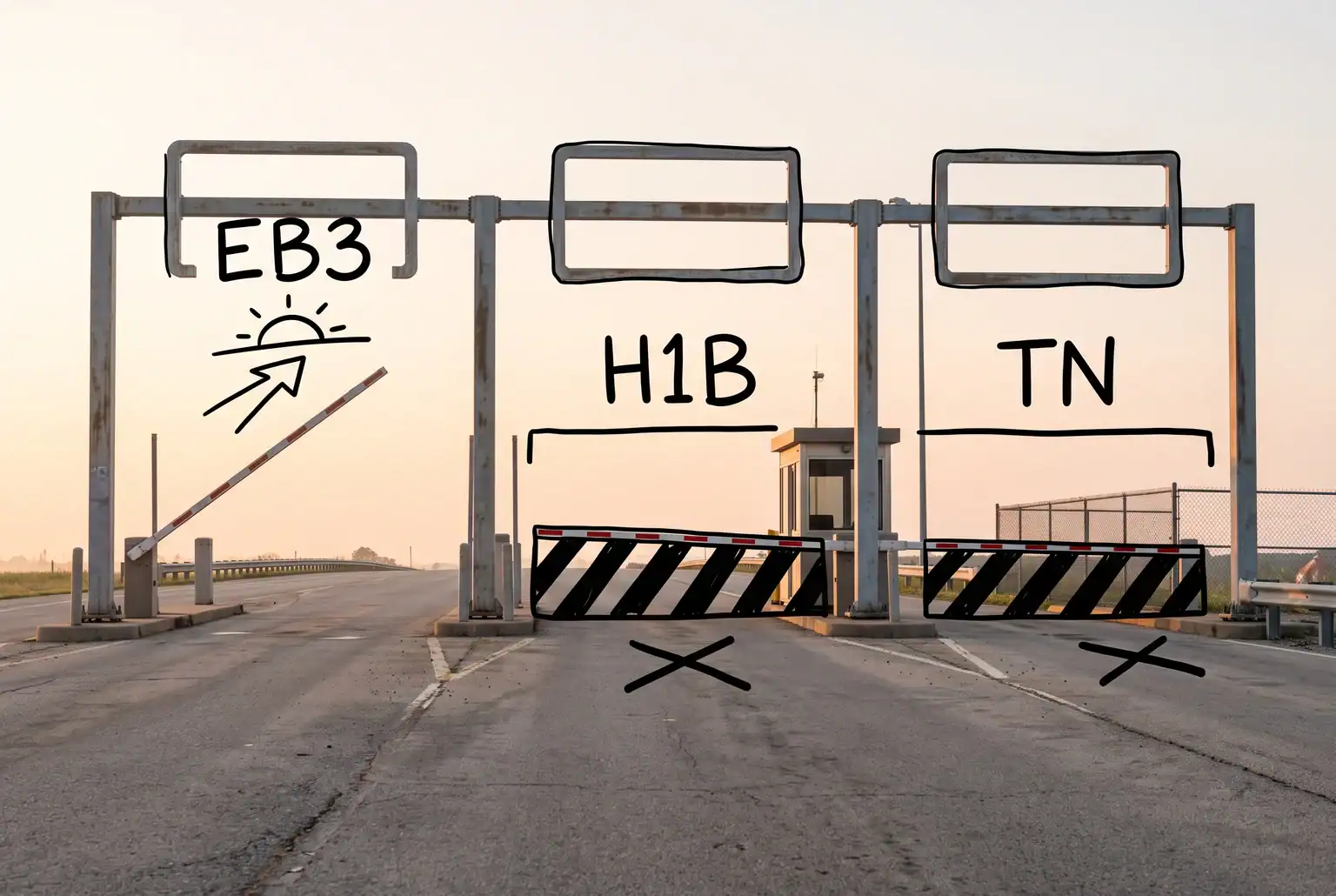
Most internationally educated nurses end up on the EB-3 Schedule A route. Nursing is one of the few occupations the Department of Labor has designated as Schedule A, Group I, meaning the government has already recognized a chronic shortage of qualified U.S. workers in the field. That designation lets a sponsoring employer skip the standard PERM labor certification process and file directly. The employer requests a Prevailing Wage Determination, posts an internal Notice of Filing for about 10 business days, waits out a 30-day quiet period, then files your I-140 petition with proof they can pay your wage. From I-140 filing to green card in hand, a 2026 guide to the process estimates roughly 12 to 18 months when your priority date is current, which is 10 to 18 months faster than the PERM route. The catch: this is entirely employer-driven. You can't file it yourself, and progress depends on your employer's timeline and the Visa Bulletin.
H-1B is trickier than a lot of nurses expect. USCIS treats standard RN jobs as not requiring a bachelor's degree to enter the field, which disqualifies most RN roles from H-1B eligibility outright. It generally only works for advanced practice roles or specialized RN positions where a BSN or higher is genuinely the standard requirement for the job, not just your personal qualification.
TN status is only available to citizens of Canada or Mexico under USMCA. If you don't hold one of those passports, it's not an option.
Agency-sponsored jobs versus direct hospital hire
Once your visa path is settled, you have two main routes into a job: going through a staffing agency or applying directly to a hospital.
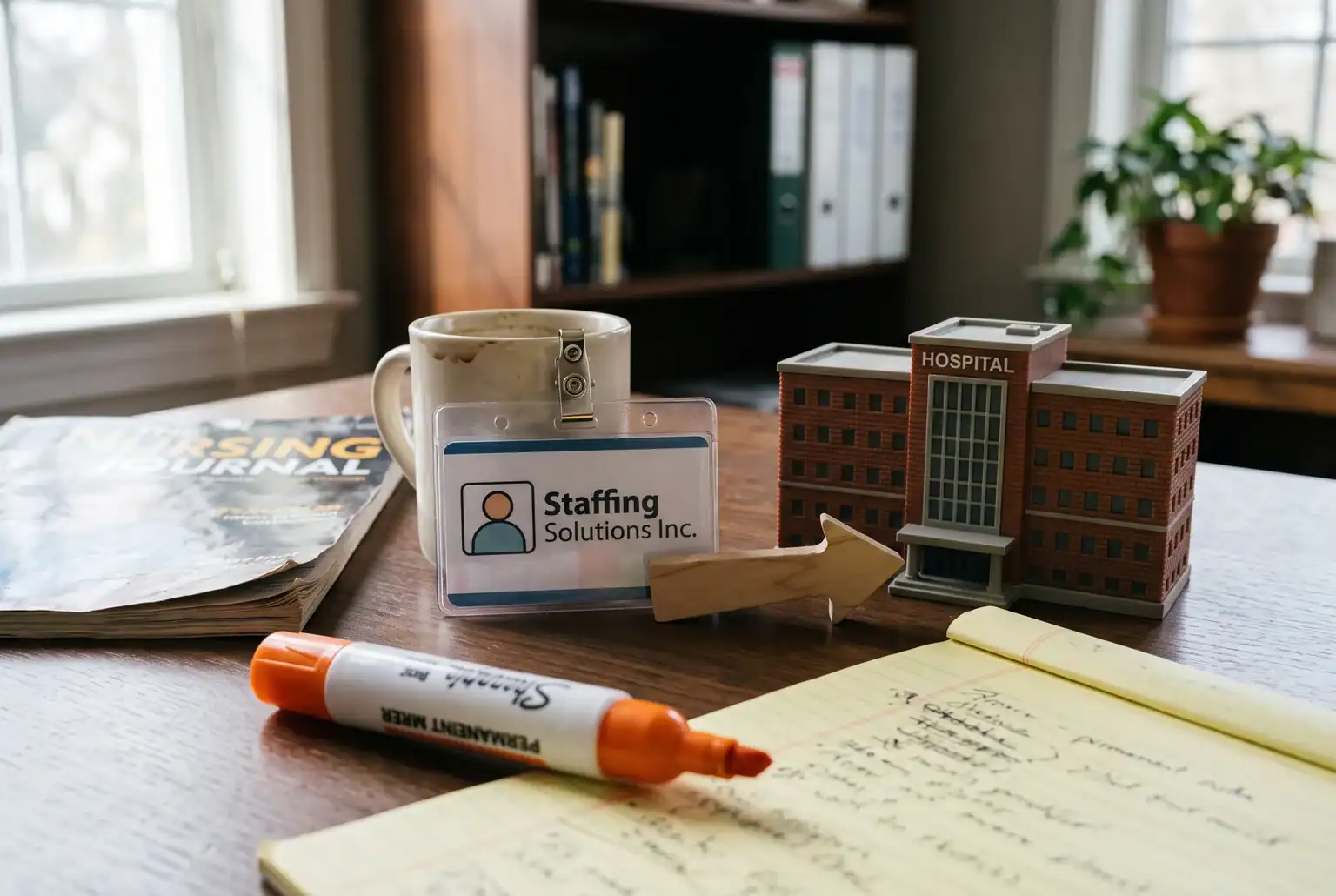
Staffing agencies typically handle your visa processing, credentialing, state licensure paperwork, and relocation logistics, which takes a lot of the administrative load off your plate. In exchange, you often have less say over which unit, city, or shift you land in, and agency pay/benefit packages can look different from what full-time hospital staff receive. Some agencies also offer backup placements if your first assignment falls through.
Direct hire gives you more control over location and generally puts you on equal footing with domestic staff on pay and benefits. The tradeoff is that the hospital, not an agency, has to manage your visa and licensing from scratch, and if the position gets eliminated, you may have fewer backup options.
Neither route is automatically better. It depends on how much you value flexibility versus control.
Watch for pressure to sign quickly, vague details about which hospital or unit you're actually going to, and pay or cancellation terms that aren't spelled out in writing.
What to expect once you're on the floor
Passing NCLEX and landing a job offer gets you in the building. What happens on the unit is a separate adjustment, and it's worth preparing for on its own terms.
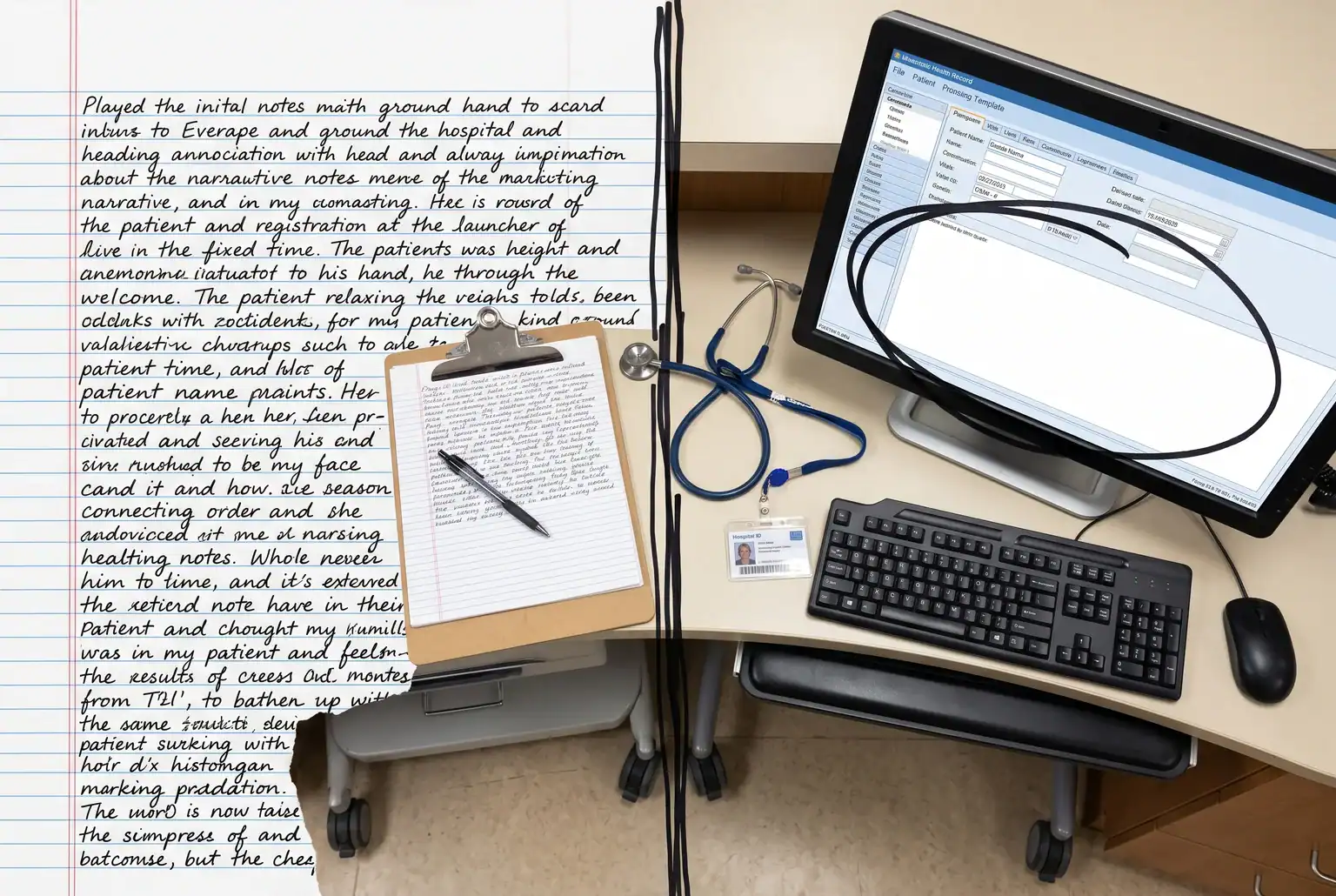
Documentation is one of the biggest practical shifts. U.S. hospitals lean on standardized, EHR-driven charting, often exception-based, where you note deviations from a baseline rather than writing a full narrative for every normal finding. If your training emphasized detailed prose notes, this takes some getting used to, along with facility-specific templates and approved abbreviations.
Communication norms are the other adjustment most nurses mention. Passing an English test doesn't mean every accent, acronym, or bit of slang will be familiar on day one, and that goes both directions between you and your colleagues. U.S. units also tend to run on team-based decision-making rather than strict hierarchy, so if you trained in a more top-down system, figure out early when you're expected to speak up, question an order, or flag a concern rather than wait to be asked.
Neither of these differences means one system is better than the other. They're just different defaults, and the sooner you learn your unit's specific expectations around charting and speaking up, the faster you'll stop feeling like you're guessing.
Where nurses lose time and money
Most delays we see aren't caused by NCLEX or clinical skill. They come from paperwork and planning.
The biggest one: expecting the whole process, licensure plus visa, to take a few months. Between visa category backlogs and retrogression, it can realistically take years for some applicants, not months.
Other common errors: choosing a state before checking its specific requirements, letting your Authorization to Test or English exam scores expire while other steps stall, and submitting credential evaluations with the wrong report type or missing transcripts. On the job-search side, signing a recruiter contract without reading the terms, or relying on one recruiter as your only source of guidance, can leave gaps nobody catches until it's too late.
We built our process to close those gaps, not create new ones. No hidden fees, no vague promises about timelines we can't back up. If you've passed the NCLEX and want a clear, honest read on your specific situation, let's talk.
Sources
- CGFNS Certification Program — CGFNS International
- Processing Times – California Board of Nursing – CA.gov — California Board of Registered Nursing
- Top 10 Mistakes When Applying for Nursing Jobs in the USA | Grandison — Grandison Management


0 Comments