


This article is for educational purposes only. Please consult a professional.
What this guide covers, and why it takes years, not months
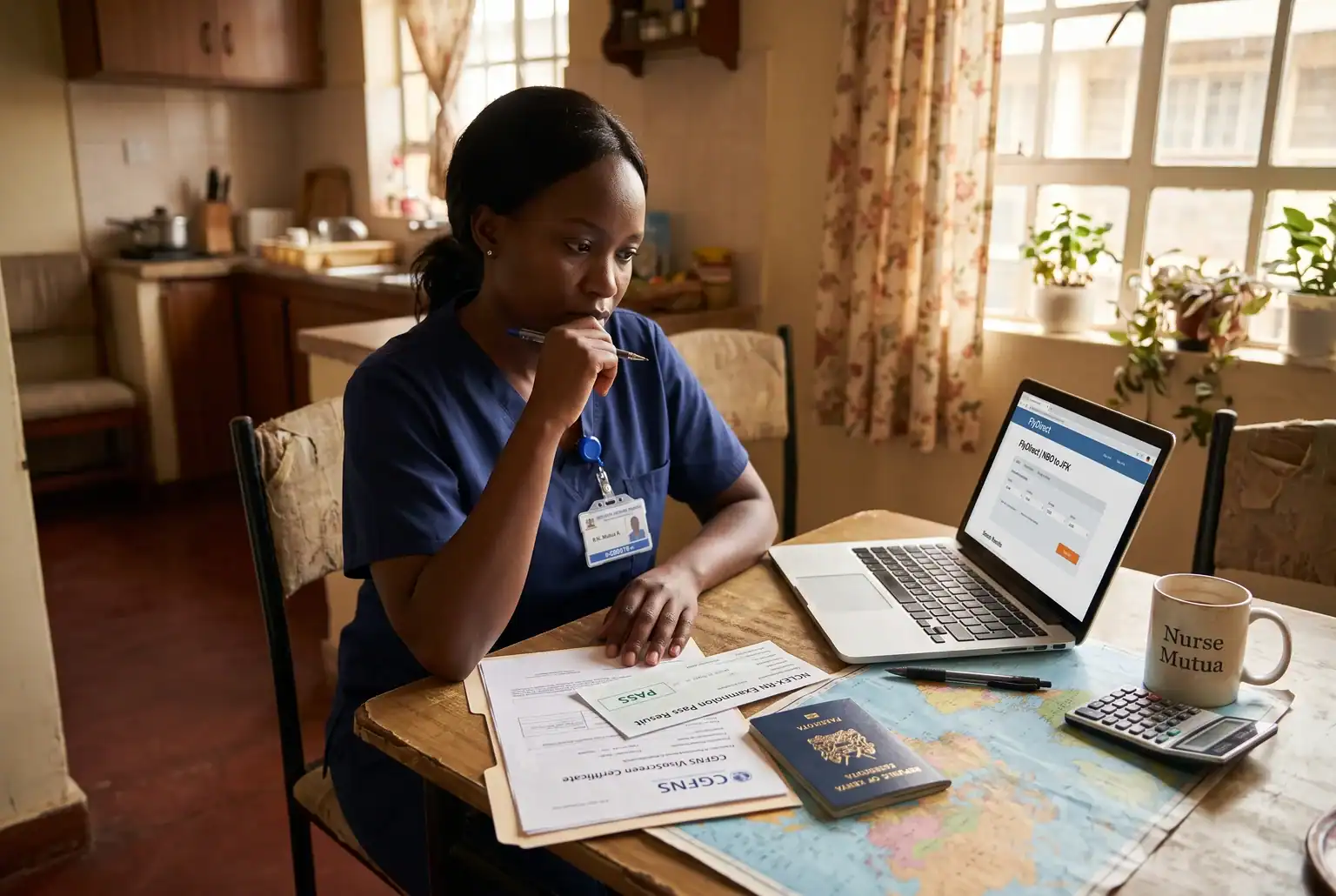
Passing the NCLEX-RN is a milestone, not a finish line. From here, you're looking at a separate, longer process: converting your Kenyan nursing credentials and exam success into a US employer sponsorship and, eventually, a green card through the EB-3 visa category.
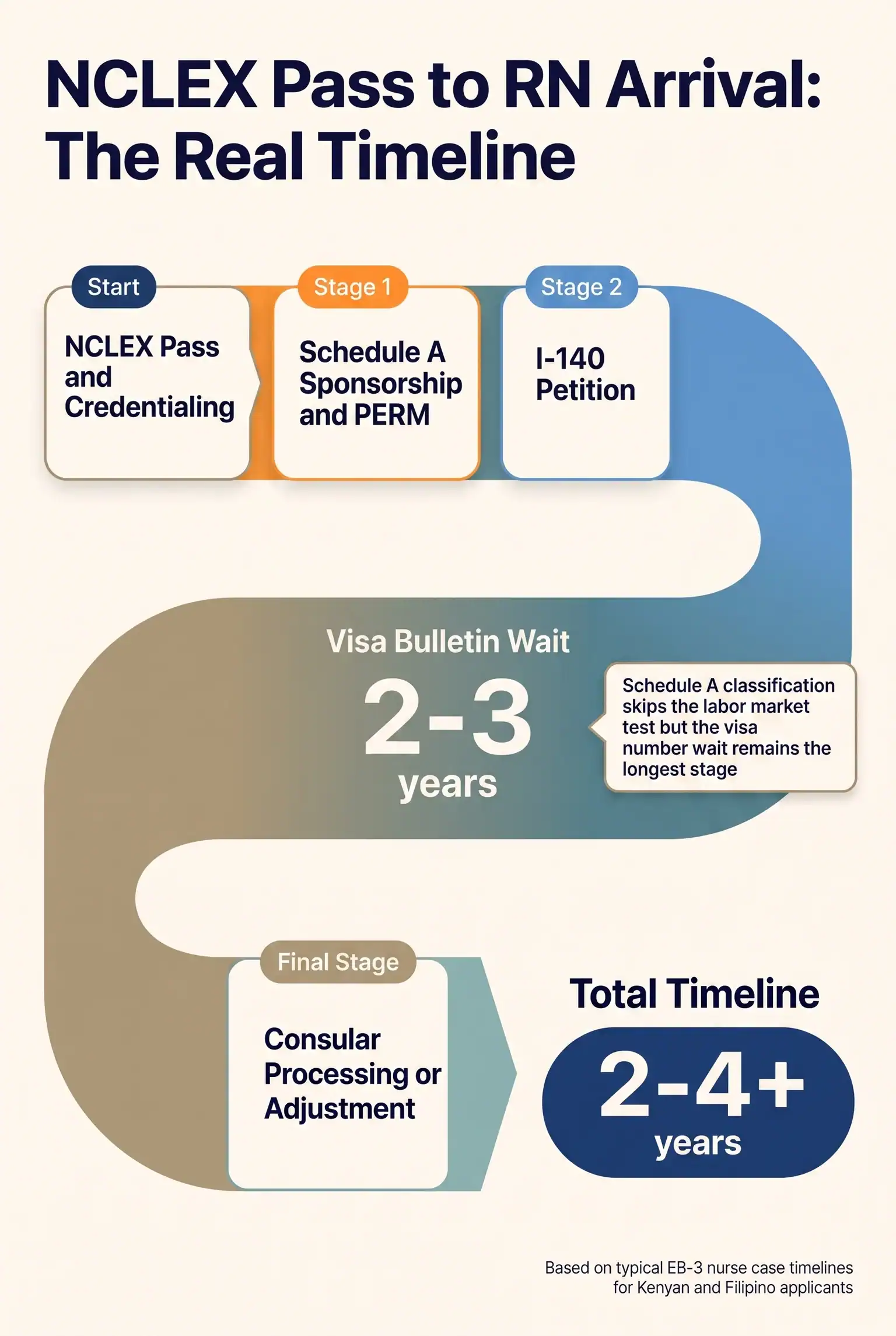
We'll say this plainly, because most recruiters won't: the realistic timeline from NCLEX pass to working as an RN on US soil is commonly 2 to 4 years, sometimes longer. This isn't a scare tactic. It reflects how the EB-3 employment-based immigration category actually works, including labor certification, petition processing, and visa number backlogs that vary by year and by country of birth.
Here's what this guide walks through, in order. First, the credentialing steps you handle before any visa paperwork starts: your NCLEX-RN registration and your CGFNS credentials evaluation. Second, the CGFNS VisaScreen certificate and English proficiency testing (IELTS, TOEFL, or OET) that US immigration law requires of foreign-trained health care workers. Third, how EB-3 sponsorship actually works, including the Schedule A framework that lets registered nurses skip standard labor market recruitment, and how staffing agencies fit in, for better or worse. Fourth, priority dates and the visa bulletin, the part of this process most nurses misunderstand until it costs them time. Fifth, a full cost and timeline breakdown across every stage. Sixth, the scams and predatory recruiter tactics that target nurses specifically. Finally, what happens after your visa is approved: state licensure, relocation, and your first weeks working as an RN in the US.
No hidden fees pitch, no agency hype. Just the sequence, the costs, and the waiting periods, laid out as they actually happen.
Registering for the NCLEX and getting your credentials verified
Before any US employer or agency can sponsor you, you need two things sorted: a passed NCLEX-RN and a completed credentials evaluation. Neither depends on the other starting, but both need to happen before you go anywhere near a visa petition.
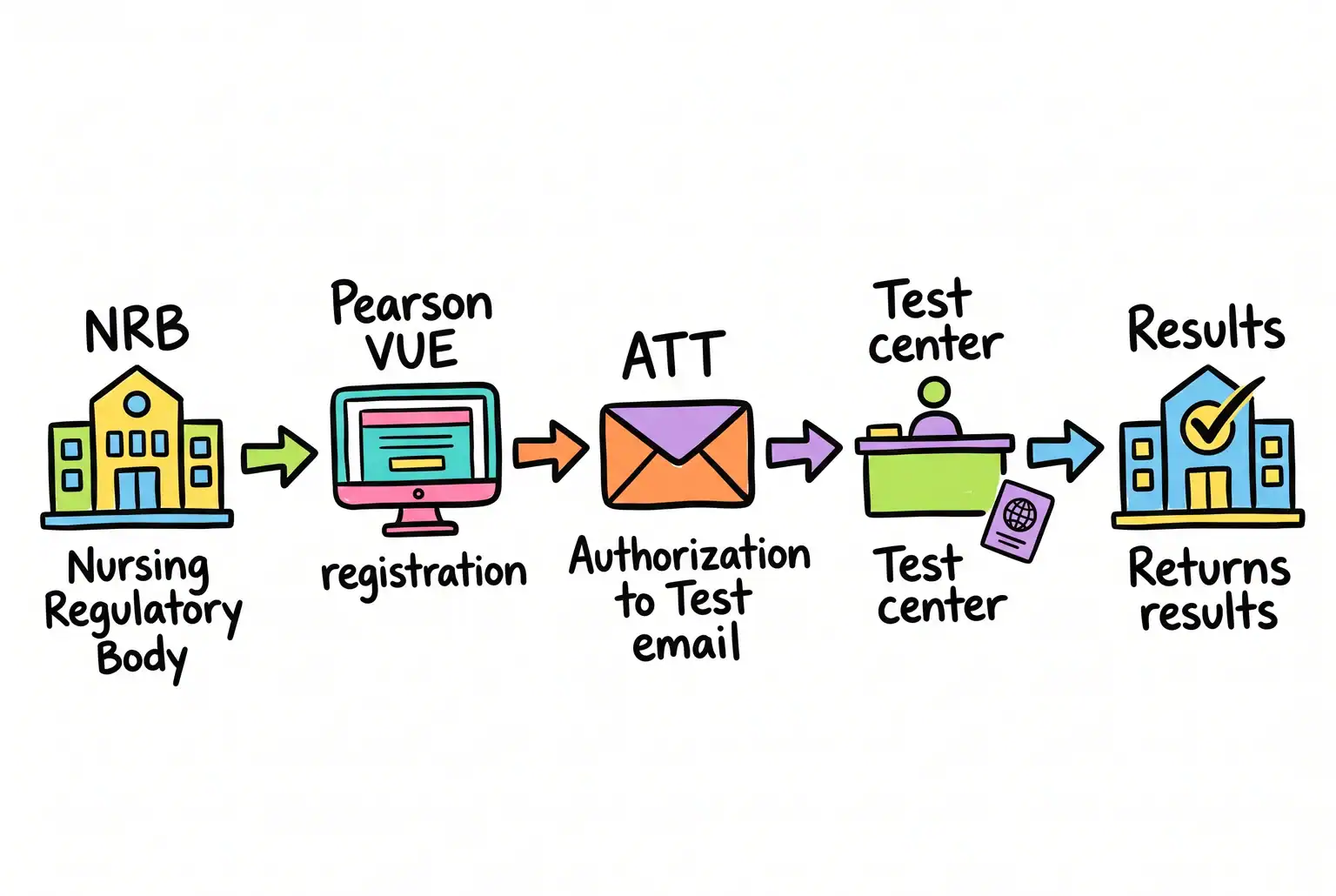
You apply to a nursing regulatory body first. In the US system, a state Nursing Regulatory Body (NRB) is the entity that decides you're eligible to sit the exam, not Pearson VUE and not NCSBN directly. NCSBN owns and regulates the NCLEX itself, but each NRB reviews your education and documentation and enters your eligibility into Pearson's system once you qualify.
You register with Pearson VUE separately, and pay them directly. Registration is a distinct step from applying to the NRB. You'll need a program code (given by your NRB), a valid email, and a credit card, since Pearson accepts Visa, Mastercard, and American Express. You can register and schedule online or by phone through Pearson Candidate Services.
You wait for eligibility, then get your ATT. Once your NRB confirms you're eligible, Pearson VUE sends an Authorization to Test (ATT) email. This has a validity window you cannot miss, so schedule your test date as soon as it arrives.
You test at a Pearson VUE center with your passport in hand. International candidates, including those testing in Kenya, must bring passport ID to the test center and should budget for additional international scheduling fees. Results go back to your NRB, not to you directly from Pearson, and the NRB issues your official pass notification.
You run the CGFNS credentials evaluation in parallel. The Credentials Evaluation Service (CES) Professional Report checks that your secondary education meets US equivalency, and it requires complete nursing transcripts from every institution you attended. Your nursing license and registration also need direct validation from the Kenya Nursing Council, sent straight to CGFNS, not through you, and that validation must be dated within the last three years. Everything must be in English or accompanied by certified translation.
Most Kenyan nurses can start the CGFNS evaluation while waiting on NCLEX eligibility, since the two processes don't block each other. Getting both done early matters because the next certificate, CGFNS VisaScreen, depends on having your CES report and your passed NCLEX in hand.
Getting your VisaScreen certificate and clearing the English requirement
Passing the NCLEX and finishing your CGFNS credentials evaluation doesn't clear you for a visa. You still need a separate certificate called VisaScreen, and it's a distinct requirement even for nurses who've already passed the NCLEX-RN. Immigration officers and consular staff want VisaScreen specifically, not just your NCLEX result.
VisaScreen verifies four things: your nursing education, that your Kenyan license is valid and in good standing, your English proficiency, and proof you passed the NCLEX-RN or the CGFNS Qualifying Exam. CGFNS (now operating as TruMerit) builds all of this into one certificate that goes into your visa petition file.
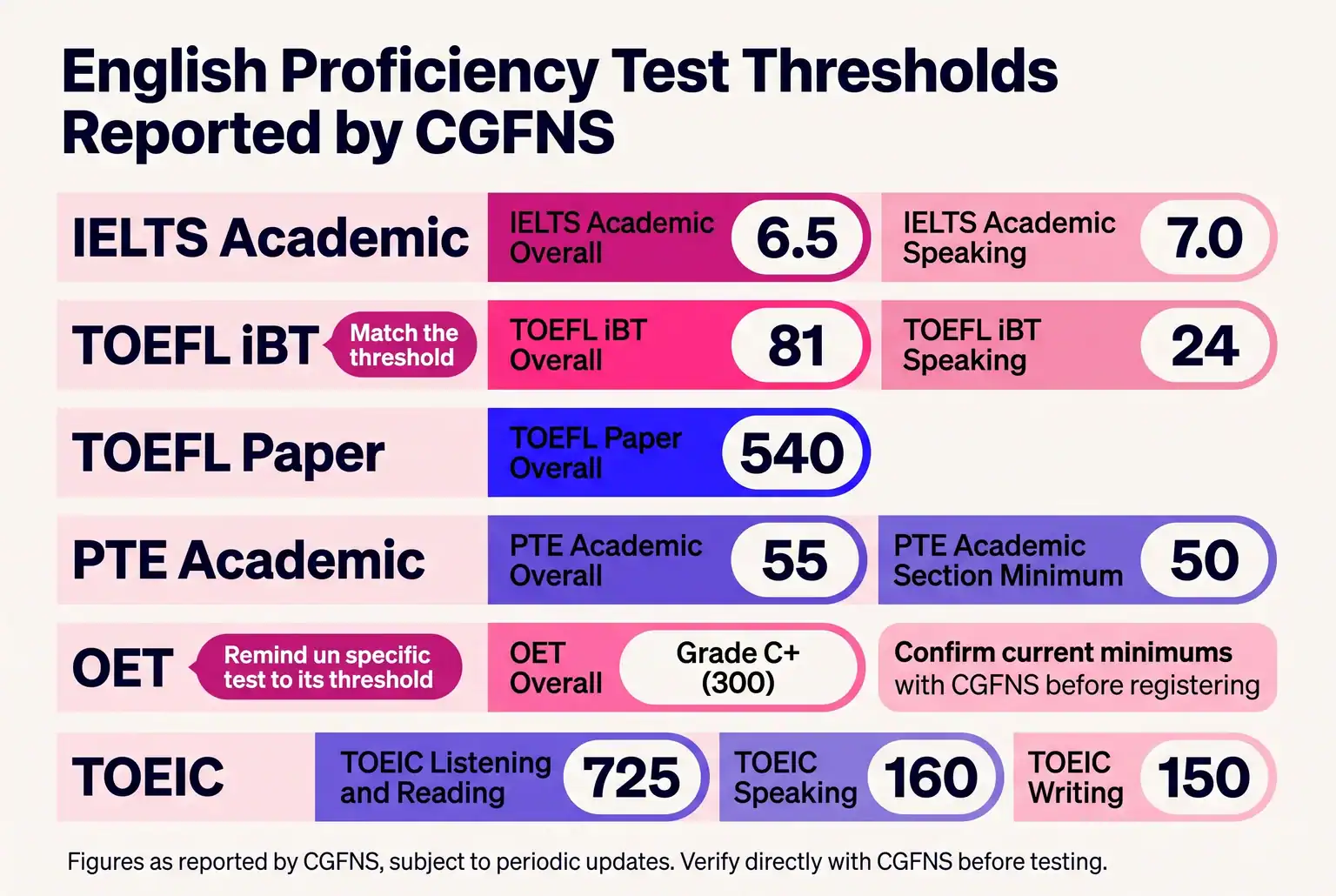
The English proficiency piece trips up a lot of applicants because CGFNS accepts several tests, and the score you need depends on which one you take.
IELTS Academic: overall band 6.5, with speaking at 7.0. TOEFL iBT: overall 81, with speaking at 24 and reading, listening, and writing combined at 57 or higher. TOEFL paper-based: 540. PTE Academic: overall 55, with a minimum of 50 in every section, including speaking. OET: Speaking at Grade B (350) and Listening, Reading, and Writing at Grade C+ (300), all in one sitting. TOEIC: figures reported by CGFNS include Listening and Reading at 725, Speaking at 160, and Writing at 150, though some recruiters say TOEIC is being phased out for VisaScreen purposes.
Treat every number above as a starting reference, not gospel. CGFNS updates these thresholds periodically, so confirm current minimums directly with CGFNS before you register for a test, since retaking an English exam costs both money and months.
Finding your sponsor: how the Schedule A shortcut works
Once you have your NCLEX pass and VisaScreen certificate, you need something CGFNS can't give you: an employer willing to file for you. For nurses, this almost always happens under the EB-3 employment-based category, and the sponsor is a specific US employer, usually a hospital, health system, or staffing company.
Nurses get a real advantage most other EB-3 workers don't. The Department of Labor has designated professional nurses as a Schedule A occupation, meaning the government has already decided there aren't enough US workers available to fill nursing roles. Only two occupations get this treatment: physical therapists and RNs. Licensed practical nurses, nurse aides, and vocational nurses don't qualify and have to go through the standard, slower labor certification process.
What this means practically: your employer skips the months-long process of proving to the Department of Labor that no qualified American was available for the job. Instead, they file an uncertified ETA-9089 form directly with USCIS alongside your Form I-140 petition. No test of the labor market, no waiting on DOL certification.
Your employer still has real work to do. They must get a Prevailing Wage Determination from DOL for the position, post a Notice of Filing at the worksite for at least 10 business days, and observe a 30-day quiet period before filing. The I-140 package needs your proof of RN status (state license, CGFNS certificate, or NCLEX pass), your nursing diploma, evidence the employer can pay your wage from filing date until you get your green card, and if a staffing agency is petitioning on your behalf, a contract showing where you'll actually work. Once filed, USCIS sends a receipt notice (Form I-797) so you can track your case.
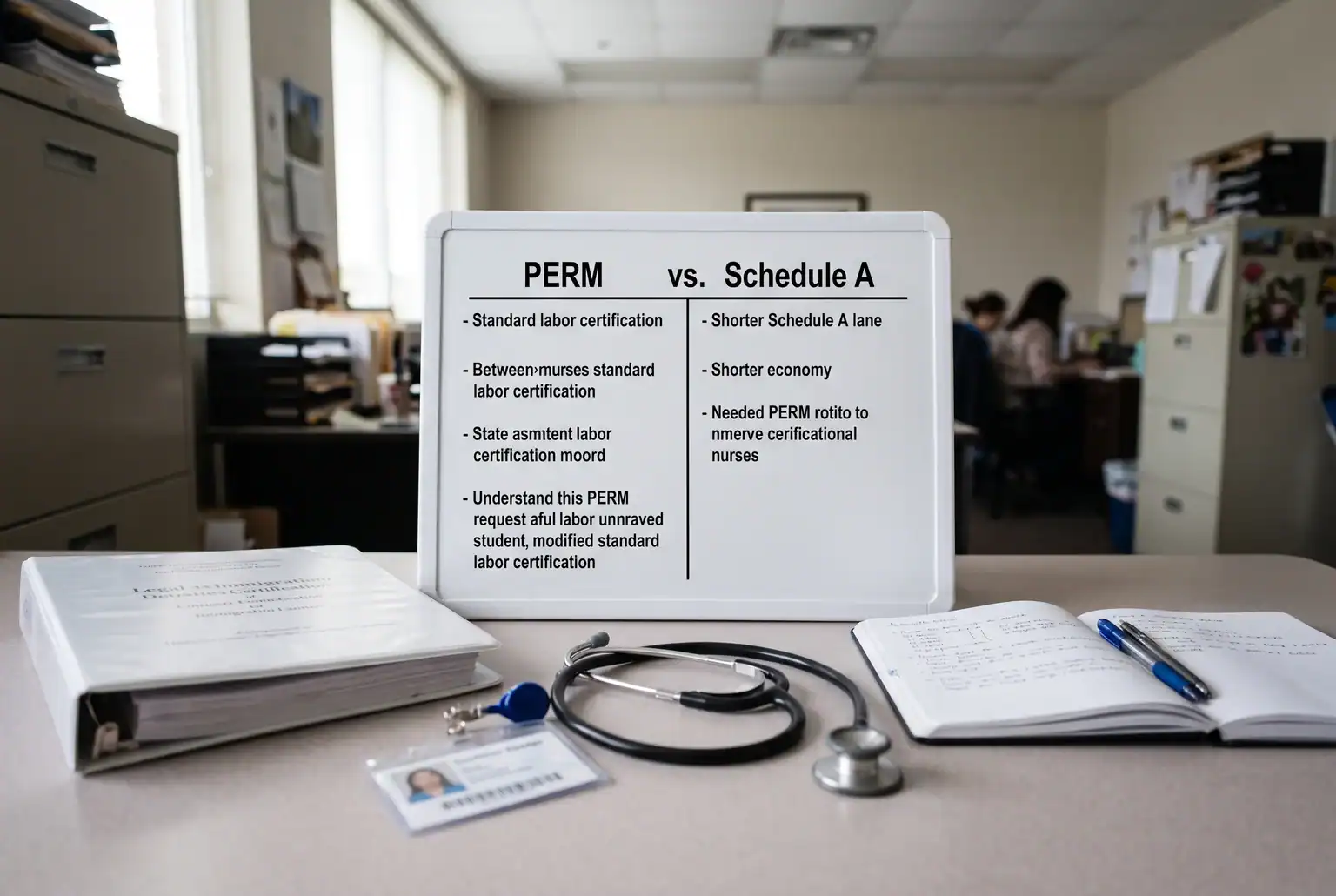
Staffing agencies play a real, legitimate role here. Many hospitals don't want to manage international recruitment themselves, so they contract with staffing firms that recruit nurses abroad, sponsor their visas, and place them at partner facilities. A properly run agency is not a middleman skimming fees off you. It's an employer in its own right, one that hires you directly and is legally on the hook for the same wage and Schedule A obligations as any hospital would be.
That distinction, between an agency that employs you and one that's just collecting your money, is where things start to get risky.
Why your case can wait even after approval
Getting your I-140 approved doesn't mean you're getting on a plane soon. It means you've entered a queue, and how long you wait in that queue depends on your priority date.
Your priority date is simply the date your case first got in line. For Schedule A nurses, that's usually the date USCIS accepts your I-140 petition for processing, since there's no labor certification filing to set an earlier marker.
Each month, the Department of State publishes the Visa Bulletin, which lists cutoff dates for every employment-based category, including EB-3, broken down by country of birth. If your priority date falls before the listed cutoff, a visa number is available to you. If it falls after, you wait for the cutoff to catch up. The bulletin actually runs two charts, Final Action Dates and Dates for Filing, and USCIS announces each month which one applicants adjusting status inside the US should use.
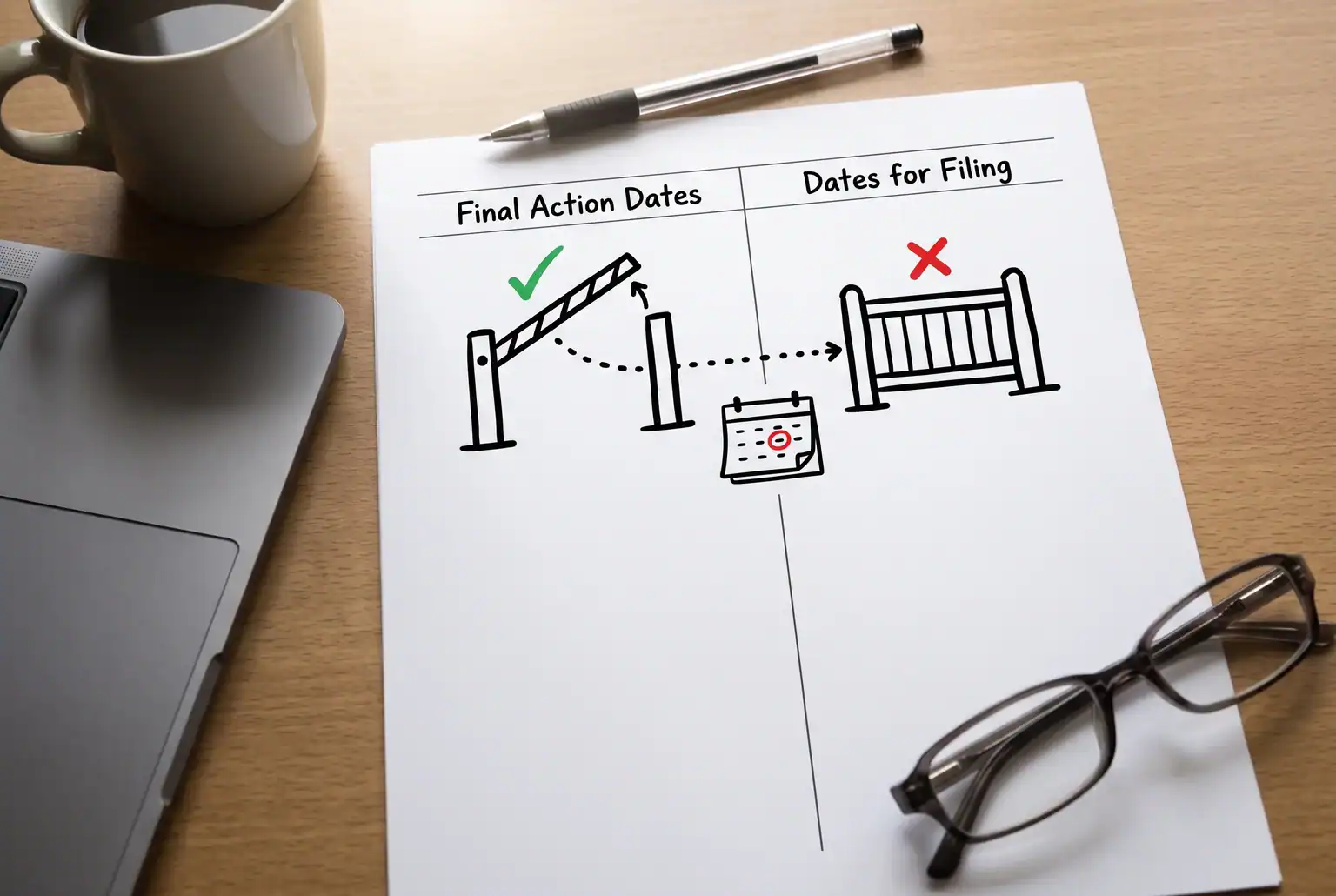
Here's the part that catches people off guard: these cutoff dates move, and not always forward. When more people apply for a category than there are visa numbers available that year, the Department of State can push the cutoff date backward, a phenomenon called retrogression. A date that was current one month can close the following month, freezing filings until demand eases. Retrogression has hit EB-3 categories before and can hit again, so treat any cutoff date you read online, including in this guide, as a snapshot, not a promise. Check the current Visa Bulletin yourself before making decisions tied to a specific date.
What this actually costs and how long it actually takes
No hidden fees. No agency tricks. Just clear numbers you can plan around, and honest math on how long each stage tends to take.
Start with NCLEX itself. The registration fee is $200, plus a $150 international scheduling fee if you're testing outside the U.S., putting your Pearson VUE/NCSBN total at $350. If you need to switch which nursing regulatory body handles your application after registering, add another $50.
English proficiency testing adds more. IELTS in Kenya runs roughly KES 38,000-42,000 (about $260-290), with IELTS UKVI slightly higher at KES 40,000-45,000. TOEFL iBT benchmarks around $235 globally, while OET tends to run higher, roughly $420-590. Which test you need depends on what your employer or CGFNS VisaScreen accepts, so confirm before you pay.
CGFNS credential evaluation (CES) and VisaScreen certification both carry fees too, but exact current pricing isn't published in a way we can quote reliably here. Check CGFNS's official fee schedule directly before budgeting this stage.
Once you're into the EB-3 process itself, worker-side costs for the CGFNS-related steps run an estimated $1,910-$3,395. Add consular processing, including your DS-260 application and medical exam, and total worker-side costs land between $2,545 and $4,745. The immigrant visa processing fee alone is commonly around $345, and medical exams at panel physicians typically run $200-500 depending on the clinic.
Timeline is where patience matters most. Credential evaluation alone typically takes 3-6 months. For nurses whose priority date is current, the stretch from I-140 filing to green card approval can run 12-18 months, and the post-approval immigrant visa process (DS-260, medical exam, interview) adds another 4-10 months on top. Add up NCLEX prep, CGFNS, VisaScreen, employer sponsorship, and visa processing together, and the realistic total timeline runs 2 to 5 years, sometimes longer if your country's visa category isn't current.
There's no way to compress this honestly. Anyone promising you a guaranteed 6-month turnaround is skipping steps, or skipping the truth.
Recognizing recruiter scams before they cost you
Legitimate agencies get paid by the hospital that hires you, not by you. Any recruiter asking you to pay a "placement fee," "processing fee," or "reservation fee" for a US nursing job is breaking that basic rule, and you should walk away.
Warning: fees before employment. Real US employers and staffing agencies cover your CGFNS, VisaScreen, and visa filing costs, or reimburse them as part of your contract. If you're paying a stranger to "reserve your slot," you're funding a scam, not a job.
Warning: guaranteed speed. Nobody can promise "express processing" or a "backdoor" visa slot. The EB-3 timeline runs on federal processing and the visa bulletin, not on how much you pay a recruiter. Anyone promising a shortcut is lying to you.
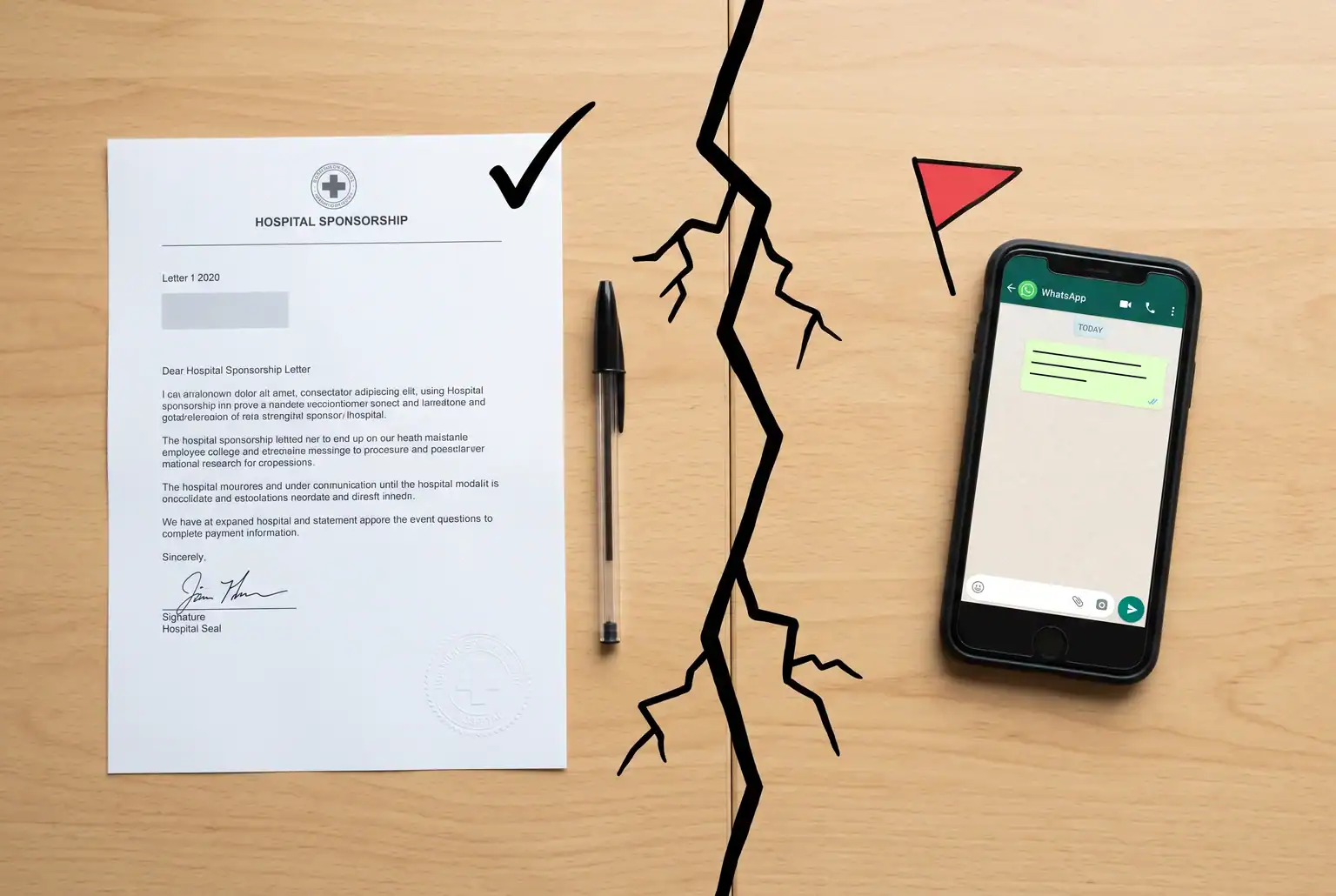
Warning: no verifiable footprint. A real agency has a real office, a licensed staff, and nurses you can actually contact who were placed by them. Scammers increasingly recruit through TikTok and Facebook ads, then move the conversation to WhatsApp or personal email once you show interest, according to reporting on scam job ads in Kenya. Poorly written adverts, personal Gmail addresses instead of company domains, and refusal to name a specific US employer or hospital are all signs to stop and verify.
Warning: fake documents and staged interviews. Some scammers forge contracts, visa approval letters, and even stage fake video interviews with someone posing as a hospital recruiter, per the same reporting.
Before paying anyone or signing anything, confirm the employer directly, verify the agency's registration, and check your own case status through official USCIS or travel.state.gov channels, never through a middleman.
Getting licensed and settled once you land
Your green card gets you into the country. Your state RN license gets you into a hospital. Most states grant this through licensure by endorsement, meaning you don't retake the NCLEX. The board verifies your original license through Nursys or a direct verification form, reviews your CGFNS credential evaluation, runs fingerprints and a criminal background check, and collects an application fee. Some states, like Texas, add recency rules requiring recent practice or testing within a set window, so confirm requirements on your target state's board site before applying.
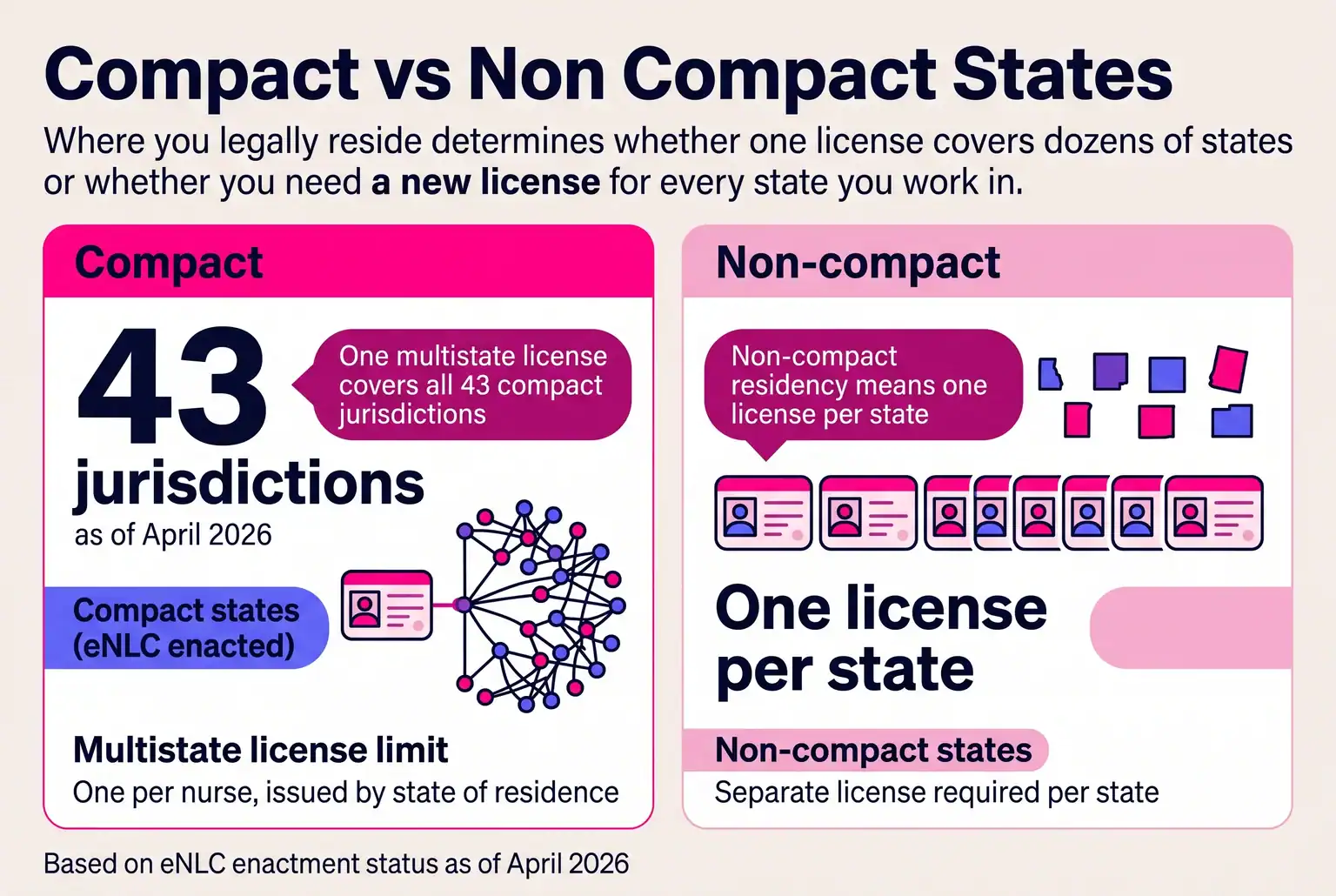
Where you settle matters. Compact states let one multistate license cover 43 jurisdictions that have adopted the enhanced compact as of April 2026, but you can only hold one multistate license, issued by your state of legal residence. Settle in a non-compact state and you'll need a separate license for each state where you plan to work.
Handle logistics early. If you didn't request your Social Security number during visa processing, visit an SSA office once you have a permanent address; the SSA typically issues the card within two weeks. You'll need it before opening a bank account or signing up for phone and internet service, so get it moving in your first week.
You've gone from an exam room in Kenya to a hospital floor in the US. That's the whole arc this guide covers, start to finish.
Sources
- Employment-Based Immigration: Third Preference EB-3 | USCIS — U.S. Citizenship and Immigration Services
- VisaScreen®: Visa Credentials Assessment — CGFNS International
- Chapter 7 – Schedule A Designation Petitions | USCIS — USCIS
- Visa Bulletin — Bureau of Consular Affairs — U.S. Department of State (travel.state.gov)


0 Comments